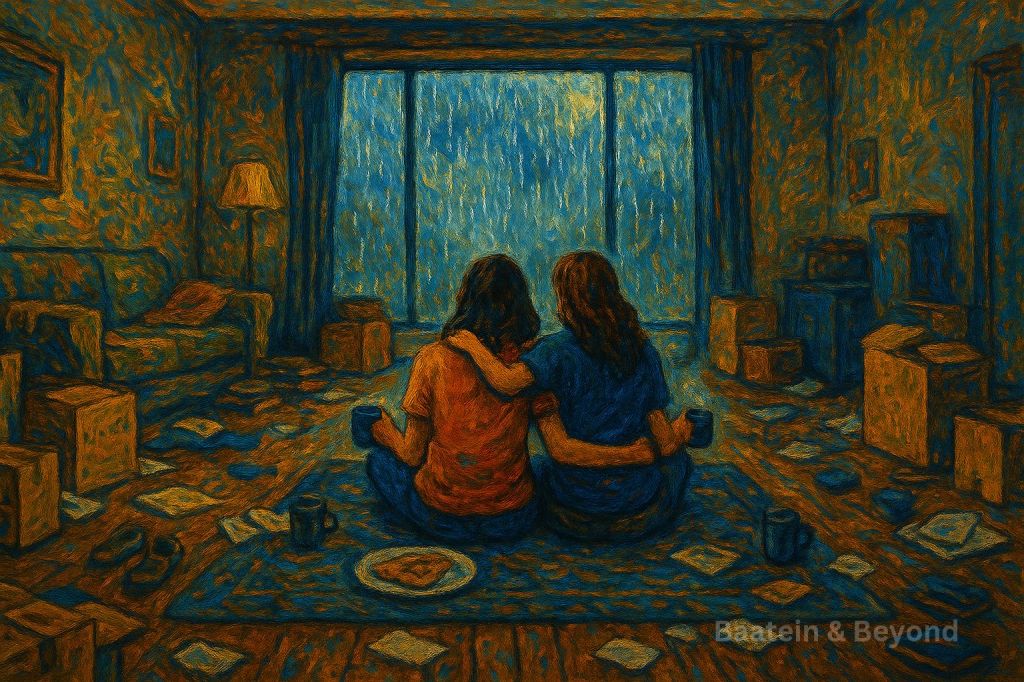
It was supposed to be moving day.
The kind of day that’s supposed to start early and borderline militant. Instead, it began with confusion, chai, and someone yelling, “Aaj phir kaam waali nahi aayi!”
Inside the flat, the scene was… chaotic. Half their life was inside boxes — some taped neatly and labeled with precision, others just flaps folded, half-heartedly, like they’d get back to them later. Which they wouldn’t. A pair of socks peeked out from a carton marked “Kitchen,” and an empty mug sat solemnly on the windowsill like it was quietly refusing to be packed.
The mattress had no sheet. The fridge was defrosted and humming like an old auntie humming bhajans under her breath. Zara had misplaced her charger again and Anmol had already sighed seventeen times.
Outside, the building was wide awake in that very specific 8 a.m. Indian-society kind of way —
Children were being ushered into school vans with toast still in their mouths.
A mother on the third floor yelled, “Beta, homework book rakh li?” at top volume.
The doodhwala’s cycle bell jingled with all the grace of a municipal alarm clock, as housewives descended with dabbas and exact change.
Somewhere in between that noise — the slap of chappals, the barking of the colony dog, and the distant echo of “Radhe Radhe” from the temple loudspeaker — Zara tried to find her left slipper.
Over the last night Anmol did most of the packing.
She had labeled the cartons in her neat handwriting —
- “Books (fragile!)”
- “Kitchen stuff (Zara’s weird mugs)”
Zara, naturally, had packed nothing except a dying money plant named Shamsher and one spoon.
“This spoon has vibes, okay? I cried into a tub of ice cream with this after my first break-up,” she defended.
“You’ve had six breakups,” Anmol shot back.
“Exactly. And only one spoon survived them all,” Zara defended.
They weren’t exactly running away from anything. Just… moving out. It was supposed to be a good thing. A bigger place. Better view. Modular kitchen. Parking spot. A society gym with exactly three treadmills and one permanently broken cross-trainer. It made sense.
But this home, this tiny rented 2BHK with its leaking balcony tap and moody geyser, held an entire chapter of their lives.
It was where Zara cried the night she didn’t get the job she thought she wanted.
Where Anmol made maggi at 2 a.m. just because Zara had a bad date.
Where the ceiling fan made that odd tak-tak-tak noise every night at 1:07 a.m.
Where their plants thrived and their bank balance didn’t.
The chaos outside had now mellowed into mid-morning lull. Inside, sunlight streamed through the half-drawn curtains. It hit the wall where their Polaroids were still pinned — crooked, dusty, and very much still there. One of them from Holi last year. Another from a rainy evening when the power went out and they danced with candles lit like two budget-level heroines.
And then suddenly, out of nowhere, the sky turned grey.
Not the moody-grey of a bored Tuesday. But, the type that creeps in slowly, like a forgotten melody playing in another room. Followed by a drizzle that tapped politely on their windowpanes, asking if it could come in.
And come in it did.
In the form of damp breeze that made the curtains billow like theatre drapes. In the way Zara’s hair frizzed up in exactly seven seconds. In the smell — mitti, old books, and chai — that made Anmol pause mid-step.
“God really said main thoda aur dramatic bana deta hoon,” Zara muttered, standing by the balcony door with Shamsher the money plant in one hand and her sole packed spoon in the other.
Just as Zara suggested they make adrak chai and watch Wake Up Sid, the power went out with a dramatic ‘thak‘. The fan stilled, the fridge sighed, and Anmol’s phone buzzed — the movers were 25 minutes away. Outside, the drizzle had turned into a downpour. Inside, the cartons sat like restless guests waiting to leave.
Panic set in, quiet but definite. They cancelled their cabs, called friends near the new place — which was waterlogged, a tree had fallen, and someone’s basement was already flooding. Anmol dialled the landlord. “Uncle… we can’t move today.” A pause. Then his voice, gentle: “Beta, sab theek ho jaaye tabhi move karna.”
And just like that, they weren’t moving out. Not today. Maybe not even tomorrow. Zara collapsed onto a cushion, Anmol laughed into her hands, and Shamsher, the dying money plant, looked mildly relieved.
“Thank god we aren’t leaving today,” Anmol said, curling her fingers around the warm cup of tea. “I’m not ready to say goodbye to this place just yet.”
Zara raised an eyebrow. “Is this the same woman who colour-coded all her cartons and threatened to leave me behind if I didn’t pack today?”
Anmol smiled. “I mean, look at this place. This stupid geyser that only works if you whisper sweet nothings to it. That light switch near the bathroom that shocks us just enough to keep us humble. Remember when you tried to toast bread on the iron because the toaster gave up?”
Zara burst out laughing. “Hey! That was innovation. Survival. Also, you said it tasted better.”
“It did,” Anmol admitted, grinning. “Charred and oddly satisfying.”
They both looked around — at the cluttered coffee table, the hand-painted wall they’d ruined together, the ancient floor lamp that buzzed like a drunk mosquito, and the faint coffee stain on the ceiling that neither of them wanted to talk about.
Anmol grinned, “Yaar, that parantha you made that day… How do you even mess up something so simple?”
Zara laughed, “Simple? I just saved us from eating it. Thank god the neighbour aunty was willing to take one for the team.”
Anmol chuckled, “Seriously, woh taste kuch alag hi tha. So, how about one more parantha today? Last day in this beautiful mess of a home — deserves a celebration, right?”
Zara rolled her eyes but smiled, “Fine, but if it tastes like rocket fuel again, aunty gets it.”
Outside, the rain softened into a silvery curtain. Inside, the air smelled of tea and old memories. They leaned against each other, sitting by the window, watching the world blur behind raindrops.
The cartons could wait. For now, the rain had gifted them one more day in a home that still remembered them.
 Baatein & Beyond