Sanjay Mehta, 45, Vice President at a LinkedIn-impressive MNC, had a routine so precise it could make a Swiss watch feel insecure.
Every morning, without fail, his alarm rang at exactly 5:45 AM — no snooze, no second beep. By 6:00, he’d be lacing up his running shoes, strapping on his smartwatch. And by 6:10, he was out — running or cycling through the still-sleepy lanes of his gated community or down quieter roads.
To the world, it was fitness. But deep down, Sanjay knew it wasn’t just about cardio. It was about finding a little stretch of time that was his, and his alone. Because the rest of his day? Pure chaos in a well-ironed shirt.
There were meetings where no one really knew what was actually being discussed. Emails marked urgent that somehow always came in at 8:01 PM on a Friday. Clients who spoke in buzzwords, and juniors who took “ownership” but not responsibility.
And then there was home. A warm, loving, but sometimes chaotic home.
He was grateful for it all. Deeply. But sometimes, when he looked at his own reflection in the bathroom mirror he didn’t quite recognize the man staring back.
That’s why he ran. That’s why he cycled. Not just to stay fit — but to escape the version of himself that was always slightly tired, slightly disconnected.
But Sundays were different.
Sundays didn’t come with pings or back-to-back calls. They came with the soft hum of tires on asphalt, the smell of damp earth, and silence that didn’t need managing. Sanjay rode further on Sundays — 25 kilometres, give or take — no stopwatch or apps. Just him, his matte black cycle with slightly over-the-top reflectors, and a playlist full of Kishore, Rafi, and RD Burman gems.
He took the highway route, past yellowing farmlands, sleepy dhabas, and early risers under peepal trees. Other cyclists chased heart rate zones; Sanjay just wanted to breathe. Pedal. Zone out.
And today — about 12 km in — he spotted it.
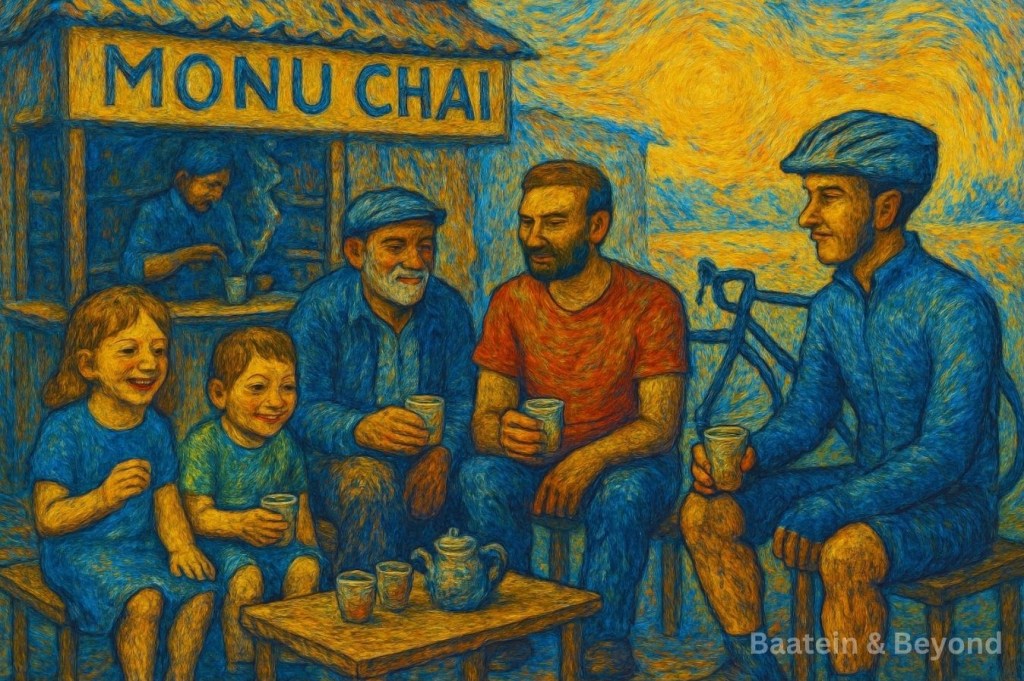
A small tea stall, barely more than a tin shed with a faded blue tarpaulin roof, a wooden bench that had clearly seen monsoons and gossip in equal measure, and a hand-painted board that read: “Adrak wali kadak chai – ₹10”.
He slowed down, coasted to a stop, and got off. Parked his cycle against a tree, took off his gloves, and sat down.
The chaiwala — early 30s, unkempt hair, a face that looked like it laughed often — acknowledged him with a silent nod and got to work. A small aluminum kettle clinked onto the burner. Flames hissed. The smell of crushed ginger hit the air almost immediately.
Sanjay leaned back, stretched his legs, and looked around. No phone. No agenda. Just… watching.
A minute later, an old man limped in, sun-worn and steady, settling onto the bench like it had been saving his spot all week. He didn’t look at Sanjay. A few minutes later, a scooter rumbled in — a delivery boy in a faded red tee, milk crates stacked high, and a grin made for convincing even unpaid customers.
He parked, yanked off his helmet, and called out, “Arre baba! Phir se?”
The old man smiled without turning. “Roz aata hoon, beta. Yeh chai na… joint oiling jaise kaam karti hai. Warna purani haddiyan chubhne lagti hain.”
The boy laughed, juggling milk packets from crate to counter.
“Aur teri mummy kaisi hai ab?” the old man asked, looking at the boy with genuine concern.
The smile on the boy’s face twitched a little — not gone, just folded.
“Wahi baba… kabhi thoda theek, kabhi thoda kam. BP aur sugar dono ne setting kar li hai unke body mein. Doctor bola bade hospital le jaao sheher mein… magar kya karein, city ka matlab paisa, time, aur chhutti — teeno cheezein thodi tight chal rahi hain.”
Then, with a practiced lightness, he shrugged and smiled again. “Kya karein… dawai kam padti hai, toh duaon pe bharosa rakh liya hai.”
The old man gave a soft chuckle, nodding slowly.
Sanjay sat quietly, watching them talk — unfiltered, easy, like the world hadn’t taught them to hold back yet. It felt foreign, that kind of openness. He glanced at the delivery boy again — young, juggling life with a practiced smile. And here he was, VP Sanjay Mehta, hiding from emails on a cycle, feeling more present at a chai stall than in any boardroom he’d been in for years.
He didn’t say a word. But something inside him shifted — just slightly — like a gear in a machine that hadn’t been used in a while.
Sanjay was pulled back from his thoughts by a tiny, chirpy voice. “Uncle, ek Parle-G aur do Eclairs.”
He looked up.
A little girl, in an oversized frock held together by a safety pin, stood on her toes at the counter. Behind her, her younger brother watched smiling — the kind of carelessness only little siblings pull off in public.
She held a crumpled ten-rupee note like it was a hundred. The chaiwala took it with a smile, handed her the packet and two toffees, and said, “Rakh le, agli baar chhutta laana.”
They sat on the bench, the girl opening the Parle-G like a pro, silently handing the first biscuit to her brother. He stayed serious — until the Eclair made him smile.
The old man watched them, biscuit crumbs now decorating their laps like sprinkles , then asked gently, “Sunday ko hi kyun aati hai, bitiya?”
She looked up mid-bite, a little surprised — not by the question, but by being asked at all.
“Papa har Sunday subah dus rupaye dete hain,” she said proudly, holding up the note like a trophy.
Sanjay’s lips curled, almost without thinking. He didn’t know their names or stories — just that this moment, dusty and sweet, felt real. Like he’d wandered into a meeting with no agenda, no slides, just life unfolding.
The kettle hissed softly. With quiet precision, the chaiwala poured three cups — one for the old man, one for the delivery boy… and one for Sanjay. No words, just a nod. Sanjay let the warmth settle in his hands before taking a slow, thoughtful sip.
Kadak. Ginger-heavy. Slightly oversweet. Perfect.
He didn’t look at his watch. For once, he didn’t care. The tea, the bench, the breeze — everything around him was unremarkable, and yet somehow… exactly right.
The old man was already getting up; the kids had finished their treat, their sugar-fuelled chatter skipping ahead of them as they walked away. The chaiwala leaned against the counter, wiping glasses with a towel that had seen better days.
Sanjay sat a moment longer. Then he stood, paid the chaiwala, adjusted his helmet, clipped into his pedals, and turned his cycle back toward the highway.
13 km left. Same distance. But something in him felt a little lighter.
“Zindagi kaisi hai paheli haaye…” played on his earbuds, and Sanjay smiled at the quiet truth of it.
 Baatein & Beyond