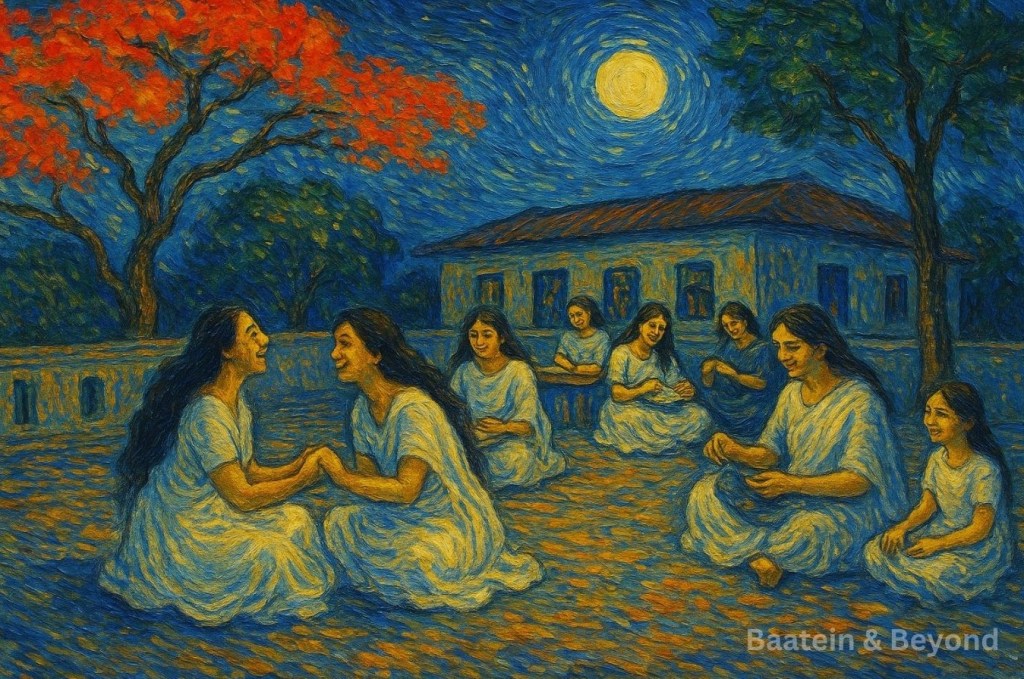
Bengal, 1906. The air was thick with change — colonial unrest below, Tagore’s verses in the wind above.
Dipanjoli, 22, arrived in Jalpaiguri with little more than a cloth bag and a bruised past. Once a schoolmaster’s bright daughter, married off at fourteen into a wealthy Kolkata home, she had survived a husband who drank, gambled, and one day never returned. His death was blamed on many things — but mostly her.
Choosing dignity over blame, she left. The vidhwa aashram in Jalpaiguri was quiet. White walls. Neem trees. Rules spoken and unspoken: no colour, no song, no memory of life before widowhood. Most women folded into silence.
But Dipanjoli couldn’t… It wasn’t that she didn’t try, but the songs that were forbidden for her now haunted her each night. So, while the rest of the aashram slept, she crept to the terrace with scraps of paper and a stolen pencil. There, under monsoon skies, she wrote poems.
She sang, too. Not loudly — never loudly. Just under her breath, like a lullaby meant for no one but the sky. Her voice would rise only when the winds did, slipping past the clay tiles and neem leaves, letting the breeze carry it beyond the ashram’s high, stern walls.
These songs were not allowed for widows. But Dipanjoli sang anyway. Rabindranath’s verses, fragments of folk melodies, poems she had once learned by heart in a sunlit classroom, long before silence became her uniform. She believed she was alone in this quiet rebellion.
Until one night, as she paused mid-verse, thinking the wind had shifted, she heard a slow clap from behind the staircase pillar. It wasn’t the breeze that had carried her song this time. It was Rohini-di.
A widow in her thirties, Rohini walked with the grace of someone who used to dance, even though her feet now carried only the weight of prayer and habit.
“I knew I wasn’t imagining it,” Rohini said, stepping into the moonlight. “You were singing Bhanusingher Padabali, weren’t you?”
Dipanjoli froze, unsure whether to hide or confess. But Rohini only smiled — soft and slow, like someone remembering a season long past. “I haven’t heard that since before my bangles were taken away,” she whispered. “Sing again. Please.”
From that night on, the terrace was no longer just Dipanjoli’s refuge. It became a hush-hush sanctuary under the stars — where white sarees loosened, and names long buried beneath duty began to rise again.
Rohini-di came first, of course. It was her clapping hands and knowing smile that turned Dipanjoli’s song into invitation. A brahmin’s daughter, who loved to dance and write couplets, now carried music in her silences.
Then came Charulata, once the pampered niece of a zamindar, who had read Shakespeare in secret under the covers of her girlhood bed. Her hands trembled as she recited “Shall I compare thee to a summer’s day?”, but her eyes lit up like she had remembered how to breathe.
Meera, the doctor’s widow, arrived with scraps of old sarees and a needle. She stitched lines of poetry into the hems — Tagore, sometimes her own — threads of rebellion disguised as embroidery.
And finally, Gauri. Barely ten. Widowed before her wrists had known bangles. She never spoke, just watched. Until one day, she whispered, “Aakash,” pointing up. Then, “Tara.” Then, “Gaan.”
Sky. Star. Song.
Her first three words of freedom.
They called themselves Antarmaala — a garland of inner light, strung not in protest, but in quiet reclamation. A secret society not of revolutionaries, but of women who had begun to remember who they were — before the white sarees, before the silences, before their names became past tense.
When it rained, they danced. When it didn’t, they wrote.
They recited lines by candlelight, wrapped each other’s feet in alta made from crushed hibiscus stolen from the temple garden. They sang Rabindranath’s forbidden verses and once even choreographed a short play — hidden behind the tall walls of the drying courtyard, under the watchful gaze of an old peepal tree.
As days passed, they began teaching some of the other women in the aashram. Reading. Writing. Dreaming.
A new sound replaced the slow toll of the prayer bell each evening — the clatter of chalk on slate, the giggles of child widows learning the alphabet by stringing together Tagore’s couplets.
One day, Gauri ran up to Dipanjoli holding a small diary she’d stitched herself. “I wrote a poem!”
She read it aloud. It was clumsy, barely rhymed. But it had colour.
She cried that night — not from grief, but from pride.
They were never ashamed of what they did. Not of the songs, nor the dancing, nor the poems stitched into hems or hidden beneath sleeping mats.
But they were careful.
They knew the world — the real world, the loud world beyond neem trees and peepal shade — would never understand. Even within the aashram, the older widows, those who had long submitted to silence, frowned at laughter that wasn’t god-bound, or at writings that weren’t prayers. So the Antarmaala stayed quiet. Not hidden out of shame, but preserved out of love. Like a flame cupped between two hands.
For years, they continued.
Some of the original women passed on — like verses softly ending. Others arrived, younger or older, worn down by the same grief, and found in the group not rebellion, but belonging.
The songs were whispered. The words were passed down. The crushed hibiscus still bloomed red on pale feet.
But the circle never broke. Antarmaala remained.
A garland not of rebellion — but remembrance.
A secret sisterhood strung through time.
Jalpaiguri, 2023.
The aashram is quieter now, most of it in ruins. Its neem trees older, its white walls chipped.
Ananya Bose, 28, archivist and accidental historian, crouched by a broken shelf inside the near-forgotten corner of the aashram’s old storehouse. She had come tracing family roots, curious to know more about a great-grand-aunt whose name had always been spoken in half-tones and unfinished stories.
It was here that she found them – a bundle of notebooks, tied with red thread. Faint, feathered writing. Poems. Songs. Names.
The ink had faded, but the fire hadn’t.
At the top of one page, in firm pencil strokes, was written: “Antarmaala. For those who still remember the sky”.
Ananya smiled through tears. Somewhere in the pages, she found herself humming a tune she didn’t know she remembered.
The world outside had changed. Sarees were no longer white, and Tagore’s songs no longer forbidden. But under the skin of time, the pulse of the Antarmaala still beat — soft, strong, and alive.
 Baatein & Beyond