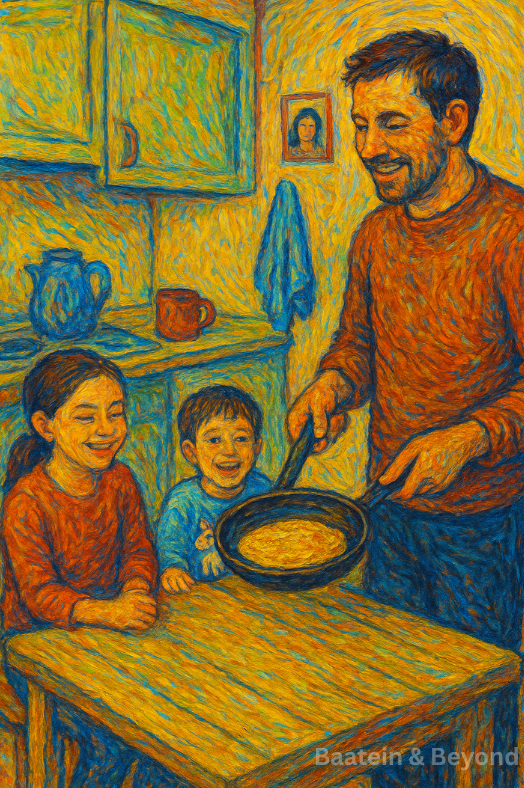
It was the third Sunday after she was gone, the house felt like someone had turned the volume down on life.
No whistles from the pressure cooker, no humming from the bathroom, no “Get up, sleepyheads!” echoing through the corridor. Just silence. Like the walls were holding their breath.
Anay woke up to the sound of birds. Shalini used to love birdsong in the morning. She was a morning person in every sense. Hair tied up messily, eyeliner from the night before still smudged under her eyes, she’d hum old Hindi songs while making tea, complain about missing socks, and somehow juggle lunchboxes, homework checks, and Advay’s toothpaste tantrums — all before her own first sip of chai.
And now… nothing. Just a cold kitchen. Her maroon mug untouched. The blue towel still on the door hook. Her recipe notebook on top of the fridge.
It had been three weeks since the accident. A cab ride. A rainy shortcut. A truck that didn’t brake in time.
He hadn’t told the kids everything. Not yet. How do you explain to a six-year-old that his mother — the one who kissed his bruises better — won’t be coming back to do it again? Or to a nine-year-old who kept asking, “But Papa, where is she now? Like actually?”
Anay hadn’t cried. Not properly. He couldn’t afford to. Bills had to be paid, clothes had to be folded, and Ira still refused to eat lauki without bribery.
But that morning, looking at her apron still hanging behind the door, something clenched in his throat.
“Papa?” He turned to see Ira, in her unicorn pyjamas, rubbing her eyes. Behind her, Advay peeked out, holding his stuffed penguin by the flipper.
“You guys hungry?” he asked, voice rough.
Ira nodded slowly. “Mumma used to make cheese omelette on Sundays.”
“I remember,” he said. “How about… Papa makes it today?”
And thus began a Sunday ritual in this family of three — stitched together with broken eggs, burnt toast, and quiet courage.
Sunday #1: The disaster
He started confidently — humming tunelessly, just like Shalini used to. But ten minutes in, the kitchen looked like it had survived a cyclone.
Half the onion burned. The other half stayed raw. He forgot the salt, overbeat the eggs till they frothed like shaving cream, and accidentally used ghee instead of butter.
The first omelette stuck to the pan like an emotional ex. The second one folded in on itself like a crushed paper boat abandoned in a monsoon puddle.
He wiped sweat off his forehead with a kitchen towel that turned out to be Advay’s school T-shirt. Still, he served it with a smile — slightly tilted on one side, just like the omelette.
Advay poked it with his spoon like it might bite him back. “It’s crying,” he whispered solemnly.
Ira took a cautious bite, chewed slowly, and gave him a very serious look. “5 out of 10,” she said finally. “For effort. And for not poisoning us.”
Anay raised an eyebrow. “That’s generous.”
They all burst out laughing — big, surprised, shoulder-shaking laughs. It was the first time they had, in weeks. Burnt edges and all, something warm had returned to the table.
Sunday #3: The experiment
By now, Anay had watched four YouTube videos titled “Best Fluffy Omelette – 2-Minute Recipe” and exactly zero of them had helped. He decided to get “creative.”
He added coriander. Then forgot cheese. Then added chilli flakes. Then remembered—mid-flake—that both children treated mild ketchup like it was hot sauce from hell. Too late.
“Papaaaa!” Advay screeched, mouth wide open like a volcano mid-eruption. He fanned his tongue with both hands, eyes wide, while Ira, ever the elder sister, yelled, “Get the milk! Get the milk!” like they were in an action movie.
They ended up downing an entire litre of cold milk between them. The omelette sat on the plate, steaming smugly. Anay stared at it like it had betrayed him personally.
That night, after teeth were brushed and tummies finally settled, Ira looked up from her blanket and said, “You know, Mumma always tapped the egg thrice before cracking it. For good luck.”
He blinked. “Really?”
She nodded. “Every time. Said it made the omelette less moody.”
The next Sunday, he tapped every egg exactly three times. Just in case.
Sunday #4: Progress
This time, things went surprisingly… okay.
He nailed the onions — golden, not burnt. He got the timing right for once, didn’t forget the salt, and even used the fancy cheese block Ira insisted Mumma used to buy “from that posh shop near the signal, remember?”
He added toast. Not burnt. Not raw. Just right. Advay gave him a high-five with buttery fingers, leaving a greasy mark on his T-shirt that he didn’t even bother wiping off.
Ira took two thoughtful bites before announcing, “Eight out of ten. Still not Mumma-level… but edible.”
He grinned like a schoolboy who finally passed a surprise test.
That night, as he tucked them into bed and started to leave, Ira’s voice stopped him at the door.
“It’s nice,” she whispered. “This Sunday thing. Makes it feel like she’s still around.”
He paused, heart tight in his chest. “She is,” he said softly, walking back to pull the blanket up to her chin. “In the kitchen. In the mess. In your cheeks when you laugh.”
Sunday #9: The day
He woke up early. Didn’t need an alarm anymore — his body had learned the rhythm of this ritual.
He chopped everything just right — not too fine, not too chunky. He used her pan, the old black one with the slightly loose handle that she’d never let him throw away. “Still has some fight left in it,” she used to say, tapping it like an old friend.
He even remembered to tap the eggs three times — once for each of them. As the omelette sizzled in the pan, the smell filled the kitchen… then the hall… then the whole house.
It smelled like Sunday.
It smelled like home.
He called them to the table — no yelling needed. They were already waiting, drawn by the familiar scent and the sound of something comforting being rebuilt.
Ira took a bite and froze, fork halfway in the air. Advay followed, chewing silently.
“Well?” Anay asked, trying not to look too hopeful.
The kids looked at each other. Then at him. And then Ira smiled — wide, lopsided, exactly like her mother’s. “Mumma would’ve liked this one.”
He didn’t say anything. Just nodded, eyes stinging slightly. He blamed the onions. Again.
That night, there was no mention of grief, or loss, or who wasn’t there. Instead, they talked about next Sunday, and whether chocolate chips could go in omelette. (Advay was firmly in favour. Ira called it “a culinary crime.”)
Just three people. One memory. And a kitchen quietly learning how to breathe again — one imperfect breakfast at a time.
 Baatein & Beyond